When evaluating High-Voltage Transmission Line Types and Differences for power grid planning, lines are categorized by how they are installed and how their circuits are configured, falling into two main groups used in practice: overhead versus underground placement, and single circuit versus double circuit construction.
- Line placement: overhead vs underground
- Circuit type: single circuit vs double circuit
Classifying high-voltage transmission lines
In electrical engineering, a high-voltage transmission line can be classified in several ways, depending on the criteria used in practice: voltage level, role in the power system, installation method, and the engineering components involved. Transmission may cover voltage levels from 69 kV to 500 kV, depending on the standard or criteria applied. To read more about each voltage level, see High-Voltage Transmission Line Standards: 115 kV, 230 kV & 500 kV Systems. To see how the two systems differ in their role within the network, see What Is the Difference? Transmission Lines vs Distribution Lines
This article focuses on classifying high-voltage transmission lines by installation type (overhead vs underground) and by circuit structure (single vs double circuit). Both are key factors when planning a line route and the structure of the power system.
Installation type
- Overhead transmission line
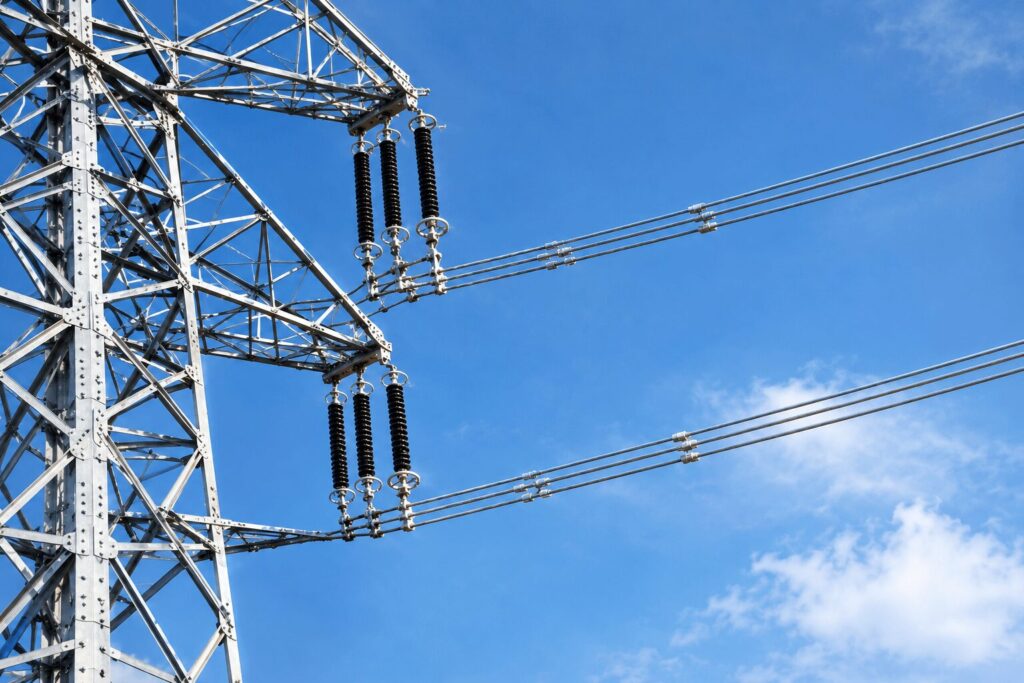
An overhead transmission line suspends its conductors from support structures in the open air above ground. It carries large amounts of electrical power from power plants to load centers or substations in different regions, over distances that can run to several hundred kilometers.
The main component is the conductor, which carries power from the sending end to the receiving end. Overhead lines commonly use bare conductors, such as all-aluminum conductor (AAC), all-aluminum alloy conductor (AAAC) or aluminum conductor steel reinforced (ACSR), which handles high tension and suits long spans between towers. At high voltage, a line may also use bundled conductors, with several wires per phase, to reduce corona, which can speed up the aging of insulators and nearby materials. For more on conductors, see ACSR, AAAC & OPGW: The Core Components of High-Voltage Transmission Line Systems.
The conductors hang in the air, which acts as insulation and carries away heat. This lets a line transmit high-voltage or extra-high-voltage power over long distances, cost-effectively and with lower energy losses. Lines of 115 kV and above are usually carried on steel towers or steel poles, the most common form for long-distance transmission.
- Underground transmission cable
An underground transmission system uses high-power cables with insulation, laid below ground. The cable may be buried directly, pulled through underground ducts, or run in cable trenches or tunnels. No towers carry the line above ground.
The conductor, usually copper or aluminum, is wrapped in insulation, with a moisture barrier and an outer sheath. Terminations and joints are designed for the line voltage and for underground conditions, following standards such as IEC 60840 and IEC 62067.
Circuit structure
In a transmission system, a circuit means one set of three-phase conductors that can deliver power as a complete system. The number of circuits on a single structure therefore sets how much power the line can transmit and how reliable the system is.
- Single circuit
A single-circuit line has one three-phase set on each tower. The structure is simple to design and build, but it has a limitation: if a fault occurs, or the circuit has to be taken out for maintenance, power stops flowing, and there is no spare circuit on the same structure to take over.
- Double circuit
A double-circuit line carries two three-phase sets on the same tower. It increases the amount of power transmitted within a single corridor and improves system reliability: if one circuit stops supplying power, the other keeps running. It also takes up less right-of-way than building two separate lines.
High-voltage transmission lines carry power from generation sources and power plants to users in each region, reliably. Choosing the right line type from the start, together with proper installation and stringing, insulator design and maintenance to the relevant standards, keeps the system running safely and efficiently and lets it serve users well over the long term.
CHC Engineering specializes in high-voltage transmission lines. It holds itself to high standards of engineering quality, accuracy and safety, so that clients can trust it as a partner at every step of their power system.
📞 Tel: 02-248-8130 | 02-248-8131 | 02-248-8132
✉️ Email: bidding@chcengineering.com
🌐 Website: https://chcengineering.com/
🔵 Facebook: CHC Engineering